H The Hale SEO Audit
Full Audit

SEO that needs to render before it can rank.

A full SEO audit of https://www.thehale.co, prepared for Hale to prioritize crawlability, structured data, content quality, AI search readiness, and growth opportunities.

Executive Summary

The site looks alive. The crawler sees a shell.

The Hale's browser experience has product listings, content, images, schema, and internal links. The initial HTML served to a normal request and Googlebot is only about 6.8 KB and contains an empty #root app shell with generic title and description.

Primary Risk
JavaScript-dependent SEO assets.

Google can render JavaScript, but relying on second-wave rendering for every title, canonical, schema block, product page, and internal link weakens discovery, consistency, and AI-search extraction.

Category Scores
Technical SEO73
Content Quality2
On-Page SEO52
Schema41
Performance87
AI Search Readiness20
Images100
6.8 KB Initial HTML

Raw homepage and Googlebot HTML were the same small app shell.

200 Crawled URLs

All sampled URLs returned the same raw title length and meta description length.

334 Sitemap URLs

Sitemap URLs resolve, but all redirect from non-www to www.

20 AI Readiness

llms.txt exists, but citability is held back by rendering and weak answer blocks.

Priority Findings

What is holding organic growth back.

Ordered by ranking impact and implementation urgency. The first four items should be treated as launch-stability fixes, not someday optimizations.

Critical Key SEO content is not server-rendered.

Raw HTML for the homepage and Googlebot contains no H1, H2, product content, images, internal links, JSON-LD, or route-level canonical. Product pages also return the generic homepage title before JavaScript runs.

Critical Sitemap URLs redirect instead of resolving canonically.

The sitemap lists https://thehale.co/..., while final URLs resolve to https://www.thehale.co/.... The sitemap audit found 334 redirected sitemap URLs and deprecated changefreq/priority tags.

Critical Raw titles and descriptions are duplicated at scale.

The crawler sampled 200 URLs and every URL returned the same raw title length and same raw meta description length. Route-specific titles exist in the rendered browser, but they are not in the initial response.

Critical Canonical strategy is inconsistent.

Rendered canonicals point to non-www URLs, while the live browser URL is www and sitemap URLs redirect to www. Pick one canonical host and make raw HTML, rendered HTML, sitemap, robots, OG URLs, and internal links agree.

High Structured data appears too late and needs cleanup.

Rendered product pages include Product schema, which is good. But raw HTML has no schema, Product schema depends on JavaScript, product pages include deprecated HowTo schema, and BreadcrumbList appears twice.

High Missing security headers affect trust and best practices.

The audit did not detect Content-Security-Policy, Strict-Transport-Security, X-Frame-Options, X-Content-Type-Options, or Referrer-Policy headers.

High Heading architecture is weak.

The rendered homepage has one H1 and no H2s. A rendered category page has duplicate H1s and a H5 for the primary product section. A rendered product page has duplicate H1s. This hurts scanning, accessibility, and AI extraction.

High Mobile UX has overlay and target-size problems.

The visual audit detected the cookie banner covering category content on mobile and several touch targets below the 44px comfort threshold, including cart controls, icon buttons, the primary CTA height, and the privacy link.

Medium AI search readiness is partially started, not finished.

llms.txt is present and substantive, and major AI crawlers are allowed. The missing piece is crawlable, answer-first content: no strong 134-167 word answer block, limited question headings, and weak attribution/update signals.

Medium Backlink authority is thin by public graph data.

Common Crawl found the domain in the 2026 Q1 web graph, but with very low PageRank and no referring-domain sample. Moz/Bing credentials were not available, so this is directional rather than a full authority audit.

Rendering Gap

Raw HTML vs rendered HTML.

This is the audit's central theme. Users see a full e-commerce experience. Raw crawlers, social scrapers, and many AI systems see much less.

Page Raw HTML Evidence Rendered Browser Evidence SEO Meaning
Homepage Generic title, generic 119-character description, empty #root, no H1/H2/images/links/schema. Home | Hale, 557 words, one H1, Organization and WebSite schema, internal links and product cards. Important content is only available after JavaScript execution.
Hair Category Same generic title and description as homepage. Hair Products | Hale, 448 words, category copy, filters, product grid, duplicate H1s, no ItemList schema detected. Category pages need server-rendered title, description, H1, intro copy, product links, and ItemList/Breadcrumb schema.
Product Detail Same generic homepage title and description; no Product schema in initial HTML. Beard Cleanser Sea Moss & Black Seed Oil | Hale, 671 words, Product schema, deprecated HowTo schema, duplicate BreadcrumbList, duplicate H1s. Product SEO exists in the browser but is fragile for crawlers and needs schema cleanup.
Raw HTML Pattern
<title>Hale - Personalized Grooming Recommendations</title>
<meta name="description" content="Hale uses real data...">
<!-- OG/Twitter/canonical tags rendered per-route by the SEO component -->
<div id="root"></div>
Fix Pattern
<title>{routeSpecificTitle}</title>
<meta name="description" content="{routeSpecificDescription}">
<link rel="canonical" href="https://www.thehale.co/{path}">
<script type="application/ld+json">{routeSpecificSchema}</script>
<main>{crawlableContent}</main>
Technical SEO

Solid performance. Risky delivery.

The lab performance profile is healthy enough to protect. The technical priority is making the existing experience crawlable and consistent.

1.79s Lab LCP

Largest Contentful Paint is in the good range based on local Lighthouse lab data.

170ms INP Estimate

Interaction to Next Paint estimate is good. Field data was unavailable.

0.03 CLS

Cumulative Layout Shift is comfortably below the 0.10 good threshold.

What Is Working

HTTPS is active, robots.txt allows public crawling, mobile viewport is present, lab Lighthouse scores are respectable, and product imagery/assets are available once the app renders.

What To Fix

Add SSR/prerendering, align the canonical host, update sitemap URLs to final www URLs, remove deprecated sitemap tags, add security headers, and stop preloading data:application/octet-stream module resources that trigger console errors.

Content And E-E-A-T

Bring the proof into crawlable pages.

The brand has a useful promise: simplify men's personal care through data and product curation. The site needs more crawlable proof that Hale is qualified to make recommendations.

Homepage

Rendered homepage word count is 557, which clears the homepage floor, but the page lacks H2 sections and answer-first blocks. Add sections for methodology, data sources, expert review, brand independence, and how the assessment works.

Categories

Category pages should include 400+ words of useful, unique intro and buying guidance. The Hair page is close at 448 rendered words but needs raw HTML delivery, better H2s, internal links, and product-list schema.

Products

Product pages have useful rendered descriptions and reviews. Make those visible in initial HTML, add comparison/context blocks, and avoid duplicate H1s or deprecated schema.

Recommended Crawlable Answer Block

Hale is a brand-agnostic men's personal-care marketplace that helps shoppers choose grooming, skincare, haircare, beard, dental, and fragrance products without guessing. The site combines a guided assessment, curated product categories, ingredient education, user reviews, and third-party brand selection so men can build routines around their skin, hair, habits, and budget. Unlike a single-brand store, Hale should explain how recommendations are selected, who reviews product claims, how ingredients are evaluated, and why certain products fit specific use cases. Add this kind of answer-first explanation near the top of the homepage and adapt it into category-specific versions for Hair, Face, Body, Beard, Dental, Fragrance, and Bundles.

Schema Strategy

Keep Product. Remove HowTo.

Schema should be JSON-LD, route-specific, server-rendered, and aligned with the canonical host.

Homepage And Categories

Server-render Organization, WebSite, WebPage, BreadcrumbList, and ItemList where relevant. Use actual social profiles in sameAs, verify the current Instagram/TikTok handles, and avoid placeholder founder values like Hale Founders if real founder attribution is available.

Product Pages

Server-render Product, Offer, AggregateRating, Review, Brand, ImageObject, and BreadcrumbList. Remove HowTo schema because HowTo rich results are deprecated and the current SEO skill flags it as a "never recommend" type.

Minimal Product JSON-LD Template
{
  "@context": "https://schema.org",
  "@type": "Product",
  "name": "{Product Name}",
  "description": "{Unique product description}",
  "image": ["{absolute image URL}"],
  "brand": {"@type": "Brand", "name": "{Brand Name}"},
  "sku": "{SKU}",
  "offers": {
    "@type": "Offer",
    "url": "https://www.thehale.co/products/{slug}",
    "priceCurrency": "USD",
    "price": "{price}",
    "availability": "https://schema.org/InStock"
  }
}
Action Plan

Fix the foundation, then build demand.

The roadmap prioritizes indexation consistency before content expansion. That keeps later SEO work from leaking value.

Week 1: Render critical SEO server-side.

Implement SSR, static prerendering, or dynamic rendering for public routes. At minimum, initial HTML should include route-specific title, meta description, canonical, OG/Twitter tags, primary H1, key body copy, internal links, and JSON-LD.

Week 1: Choose and enforce the canonical host.

Use https://www.thehale.co/ everywhere if www is the final host. Update rendered canonicals, raw canonicals, OG URLs, sitemap URLs, robots sitemap directive, internal links, and schema URLs.

Week 1: Rebuild sitemap and robots.

Generate a sitemap with only final 200 URLs, remove priority and changefreq, keep accurate lastmod, and reference the final sitemap URL in robots.txt.

Weeks 2-3: Clean schema and templates.

Move Organization, WebSite, WebPage, BreadcrumbList, Product, Offer, Review, and ItemList schema into server-rendered templates. Remove HowTo schema and duplicate BreadcrumbList output.

Weeks 2-4: Fix headings and category copy.

Use one H1 per page. Add H2s for methodology, product types, concerns, ingredients, FAQs for users, and recommended routines. Expand category pages with unique buyer guidance, not only filters and product cards.

Month 2: Build topical authority.

Create crawlable guides around men's skincare basics, beard routines, ingredient explanations, hair product selection, deodorant choices, fragrance buying, and routine-building. Link these guides into category and product pages.

Month 3: Earn and consolidate authority.

Use brand partner stories, founder/team expertise, review methodology, earned media, and digital PR to strengthen E-E-A-T and backlinks. Add About/team proof to the site, not only social channels.

Screenshots

What users see.

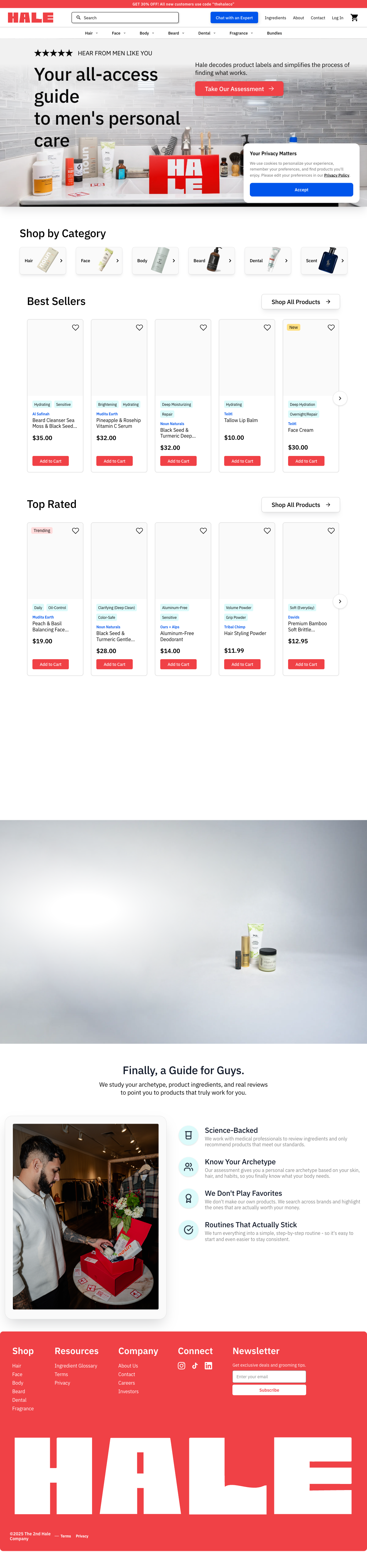
Screenshots confirm the rendered site has a real shopping experience. That makes the render gap more urgent: the content already exists, it just needs to arrive in crawlable HTML.

Desktop screenshot of The Hale homepage
Desktop homepage capture. Cookie banner overlaps the lower hero/right area and product image slots were visibly unstable during capture.
Mobile screenshot of The Hale homepage
Mobile homepage capture. Cookie banner overlaps category content; multiple touch targets are smaller than recommended.
Evidence Appendix

The receipts.

Collected with the installed SEO skill, live browser rendering, raw HTML fetches, robots/sitemap checks, Lighthouse lab data, Common Crawl graph data, and Google Search Console property availability checks.

ScopeThis report audits https://www.thehale.co and its public crawl, rendering, sitemap, schema, content, performance, image, and AI-search surfaces.
Raw HTMLHomepage default and Googlebot fetches both returned 6,840-byte HTML shells with generic title, generic description, app scripts, and empty #root.
Rendered HomeBrowser-rendered homepage: title Home | Hale, 557 words, one H1, zero H2s, Organization and WebSite schema.
Rendered CategoryHair category: title Hair Products | Hale, 448 words, duplicate H1, H5 product section, two schema blocks.
Rendered ProductProduct detail: title Beard Cleanser Sea Moss & Black Seed Oil | Hale, 671 words, duplicate H1, Product schema, HowTo schema, duplicate BreadcrumbList.
Crawl Sample200 crawled URLs had same raw title length and same raw meta description length, indicating route SEO is not present in the initial HTML.
Sitemap334 sitemap candidates; all sitemap URLs redirect from non-www to www. Deprecated priority and changefreq tags are present.
RobotsPublic routes are allowed; private/auth routes and API routes are disallowed. Robots references https://thehale.co/sitemap.xml, not the final www URL.
PerformanceLocal Lighthouse lab data: Performance 87, SEO 76, Accessibility 90, Best Practices 88, LCP 1,792 ms, INP estimate 170 ms, CLS 0.03, TBT 119 ms.
Google DataGSC access was not available for The Hale in the configured account. PageSpeed API public call returned quota exhausted, so no CrUX field data is included.
BacklinksCommon Crawl graph: domain present in 2026 Q1 release, very low PageRank, no referring-domain sample. Moz/Bing credentials were not configured.
AI Searchllms.txt is present and substantive; major AI crawlers are allowed. Score is 20/100 because crawlable answer-first passages, headings, and attribution are weak.
SecurityMissing security headers detected: CSP, HSTS, X-Frame-Options, X-Content-Type-Options, and Referrer-Policy.
Third PartiesObserved GTM/GA, Meta Pixel, Klaviyo, Mixpanel, Shopify Buy Button, Shopify CDN assets, and an OnRender product API. Keep performance monitoring in place as features grow.